My name is Tommy Sutor. I am a CSCS through the NSCA, and have a Master's Degree in Exercise Science. I am the program director at Push to Walk, a specialized intensive exercise gym for people with spinal cord injuries and other types of paralysis. With this blog I hope to share lots of information and research pertaining to my job, other topics related to health and exercise, and, if I think you may be interested, my life.
On the left, 2008 Olympic marathon gold medallist Sammy Warinju. On the right, 2008 Olympic weightlifting silver medallist in the men's 232 lbs weight class, Dmitry Klokov. Who do you think has the stronger legs?
This one is for all my family, friends, acquaintances, and enemies who adhere to the belief that they do not need to do weightlifting for their legs, because they run, bike, or spend time on the elliptical. If you spend time in the gym/weight room with the goal of getting strong, big, powerful, building endurance, or all of the above, you need to lift weights, or at least engage in some kind of resistance training, for EVERY part of your body. Period.
Running, biking, going on the elliptical, or doing some other kind of long duration aerobic work alone will not give you big, strong, or powerful legs, nor will it give you the other various benefits that resistance training will. Sprint training, however, is a good compliment to these things, but it works better when combined with weightlifting. Something you can get from aerobic work on these machines is local muscular endurance, so if that is your goal, than doing these things without weightlifting is fine, especially for endurance athletes. Running, biking, or ellipcitcal-ing will not give you any of the other same adaptations as other types of resistance training. Here's why, in a nutshell:
1. Long duration aerobic work does not elicit the right kind of muscle contractions to build size or strength.
2. Long duration aerobic training does not stimulate the type of muscle tissue that gets you big or strong as a result of resistance training.
3.Long duration aerobic training does not put the same stress on the body that resistance training does, and thus will not result in the same benefits.
Those are the main reasons that the treadmill, bike, etc will not give you the same results as resistance training. I gave that short list because the scientific explanations behind those reasons are lengthy. If you want a more in depth explanation as to why you need to suck it up and do squats, keep reading.
1. Lack of Eccentric Muscle Contractions.
An eccentric muscle contraction is one where the muscle contracts while actually getting longer, such as the phase of a bicep curl where you lower the dumbbell from your shoulder back down to arm's length. Eccentric contractions are important because it is the eccentric portion of a movement in which the main stress is put on the muscle that will cause it to get bigger (and to a lesser degree, stronger). When on an elliptical or cycling machine, there is no eccentric phase to the movement - in other words, there is no type of contraction that results in bigger or stronger muscles. When running, there are eccentric contractions (they happen every time your foot hits the ground). However, they are through a very short range of motion, they don't last the same length of time, and they do not bring forth as much force as eccentric contractions induced from resistance training do.
2. Lack of stimulation to type II muscle fibers.
We have two main types of muscle tissue in our body that cause movement - type I and type II muscle fibers. Type I fibers cannot produce a lot of force and resist fatigure very well, so they are our main endurance muscle fibers. Type I fibers also do not get much bigger, no matter what kind of training you do. Sammy Warinju up top is chock full of type I muscles. Type II muscles, on the other hand, fatigue quite easily, but can generate a ton of force. They are the "fast twitch" muscles in our body, and they can grow considerably in size due to resistance training. Dmitry Klokov is made up of mostly type II fibers. Unless you are doing some kind of sprint training that requires short bouts of high force generation, no amount of time on the treadmill, elliptical, or bike is going to stimulate the type II muscle fibers in your legs. As a result, no amount of time on the treadmill, elliptical, or bike will give you the size, strength, or power results you might be seeking during your time at the gym.
3. Lack of necessary stress to the body.
When I say "stress", I mean positive stress from exercise that is actually healthy for the body to endure. Any weight bearing activity will cause adaptations to the body such as increased bone density, increased muscle strength, and enhanced tendon/ligament health. However, the degree to which these adaptations takes place depends on such things as the loads put on the tissues/joints, or the range of motion through which they move.
Any movement we do on aerobic training machines rarely moves our hips, knees, or ankles through the same range of motion that many weightlifting exercises can. Even if you do crank up the "incline" on the elliptical and you have to lift your knees really high, the force that our muscles must generate and that our joints and bones must sustain will still not be as high as when doing something like a squat or deadlift.
So yes, I'm saying the fact that a squat or deadlift stresses the body more than running or cycling is a GOOD thing! When these exercises are done with proper technique, the stress on the body leads to our muscles, joints, and bones re-building themselves to be even stronger than they were before - not to mention stronger and healthier than aerobic machines can ever make them!
I'm not saying nobody should ever do cardio. Trust me, I'm not one of "those guys". Cardiovascular training is very important, and lots of people enjoy aerobic machines and should use them as much as they want to. Just don't expect your legs to be as big, strong, or healthy as they possibly can be if cardio machines are the only training you ever do for your legs!
I almost forgot - resistance training results in LIFELONG health of the lower body!
In the quest to get healthy and meet health related goals, a lot of people have started logging their workouts or counting their calories using online exercise journals and caloric intake/expenditure calculators. My girlfriend recently started using one herself, so of course I was skeptical (since I'm skeptical of just about everything) and had to investigate. I will go through the pros and cons of such web sites by going over a few features of the food and exercise logs and calculators on http://www.livestrong.com/, as this is the one my girlfriend has been using and I have gone through with her.
Pros:
It helps you meet goals you set: My girlfriend's main goal is simply to lose weight. Putting her age, height, and current weight into a calculator on the web site gave her Basal Metabolic Rate, or BMR, which is the number of calories you burn simply from existing. Then she picked her goal of losing one pound per week (which is a great goal, as it is healthy and realistic!). Based on her BMR and her weight loss goal, she is given a target number of calories to consume each day to meet her goal.
Calorie counting: The MyPlate feature of livestrong.com lets you enter the food you ate and tells you how many calories you get from carbohydrates, fats, and protein in that food. This makes counting the calories you consume through the day very quick and simple. It also lets you see how much food (and how much of which foods) you ate, which helps you spot if you are eating too much of one thing or not enough of another. You can even track how much water you drink throughout the day!
Logging your exercise: The same feature on the livestrong web site lets you input what kind of exercise you did that day, and how long you did it for. You can also input general physical activity, like gardening. It then tells you how many calories you expended doing those activities. This allows you to track your exercise and physical activity to see how much you really do from day to day.
Showing the relationship between diet and exercise. The coolest feature of the livestrong web site is that it calculates caloric intake from food and caloric expenditure from physical activity all at once. It then shows you if you are over or under your goal for the day. For instance, if your caloric intake goal is 1,500 calories a day, and you consume 1,700 calories but burn 300 calories throughout the day, your net caloric intake is 1,400 calories, and you have met your goal! This is a great visual representation of how it takes BOTH diet and exercise to lose weight (or meet any fitness goal).
Cons:
Body composition doesn't seem to be addressed. I didn't find anything on how much of your body is fat weight vs. lean weight (which is bones, muscle, skin, everything on your body other than fat.) While there is no good way to assess one's body composition without using equipment in person, it would be good to at least have a mention of it somewhere. When trying to lose weight, losing fat is good - losing bone, muscle, or fluid, however, is not!
The numbers are not 100% accurate. It's necessary to measure exact serving sizes to get an accurate caloric measure of the food you eat, which most people don't do. Same thing with exercise - its possible that even two people of the same size can expend a different amount of calories when doing the exact same exercise. This is not to say that the numbers are wildly off-base, as most of them give you a general idea of what you have eaten or expended. Just not an exact amount.
So are they good to use or should I not bother?
I think online journals and logs like this are great tools for someone who is just starting out exercising or changing their eating habits. They let you visually see what you eat, what you don't eat, and how much exercise you do or don't do. This is a great tool to have when trying to make lifestyle changes. People simply need to keep in mind that when losing weight, they should try to focus on losing excess mass (fat) and not lean mass (bone and muscle). The numbers from these sites also shouldn't be taken too literally, as they will never be 100% accurate. But they can be very good guidelines that can set you on the right path to your fitness goals.
Meeting fitness goals is much easier if you can SEE what you are doing each day, and online logs make that convenient and easy to do.
Well, its a day late, but here it is, my newest health tip of the week! This one deals with the importance of
muscular endurance as it relates to the muscles of the trunk and hips.
The muscles of the trunk and hips are ones that stabilize the spine, and all its related structures. If the spine is not held in alignment for long periods of time, tissues can get damaged, nerves can get pinched, discs can slip/herniate, etc - in short, an unstable spine = back pain.
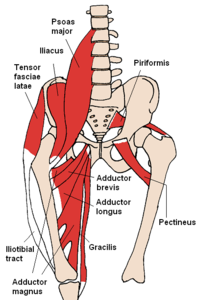
So what do the muscles of the hips have to do with the spine? Well, the muscles of the hips are connected to the pelvis, which is the base of the spine. Many muscles connect the pelvis to the spine as well. Thus, it is possible to have a structurally healthy spine, but if certain muscles of the hips are too tight/too flexible, or too weak/too strong, the pelvis can be pulled out of alignment, which in turn will affect the spine as well.
A few illustrations showing how many muscles attach to both the spine and pelvis, or the femur (thigh bone) and pelvis. If just one of those muscles connected to the pelvis is too weak, tight, or loose, it can effect all the other connected structures!
Ok, so the spine, pelvis, and all connected muscles are interrelated. Why is endurance of the trunk and pelvis musculature important? We spend most of the day either sitting or standing up. That whole time, our spine needs to be held in proper alignment. All day. Every day. Hence, if those muscles that stabilize our spine are not able to work for long periods of time, they get tired, and can't hold our backbones or pelvis in the proper position anymore!
I've heard that just the abs (or psoas, or multifidus, etc) need to be strong to alleviate back pain. Is that not true? It is not just one muscle that holds our spine and pelvis in proper alignment - it is ALL of the muscles on all sides of our trunk and hips that do this work! If one muscle is weak, tight, or loose, it can cause problems, but one specific muscle doesn't do all the work for one task. Our back muscles, obliques (muscles on our sides), our abs, and a whole host of deeper muscles (such as the psoas or multifidus) must all work together to brace our spine in a healthy position.
Alright, so what exercises should I do to increase my trunk-hip muscular endurance?Isometric exercises (exercises where you don't move) or, what I have begun to call iso-dynamic exercises (ones in which you are moving, but are trying to keep a certain part of your body still) are just as good as any type of sit-up, crunch, or dynamic trunk exercise, and they might very well be more applicable to what we do in the real world. Lets elaborate:
Isometric exercises
The king of all isometric trunk and hip exercises is the plank and all its variations. You can also do bridges, which target the lower back and the gluteal muscles (your butt). Different types of planks target different areas of the trunk and hips, but they all force your muscles to hold your spine, hips, and/or whole body in a straight line. Make sure to do different types of planks to hit your trunk and hips from all sides!
Iso-dynamic exercises
As I said earlier, an iso-dynamic exercise is one where you are moving your whole body, while trying to keep one part or parts of your body from moving too much. Two examples are the bottoms-up kettlebell carry, and the overhead carry with a slosh bar. Both exercises invlove walking (the dynamic part), while your trunk and hips (as well as arms and shoulders) must hold the unstable load still while you are walking (the isometric part). This static action of the trunk and hip muscles makes them work, which braces your spine and holds it in proper alignment.
So whats the best way to go about adding exercises like these to my workouts?
Here are the two ways which I believe are best:
At the end of your workout, do two or more sets of different plank/bridge variations. Along the same lines, at the end of your workout, do two or more sets of some kind of iso-dynamic exercise, carrying the load for as long a distance as possible. For the best results, do at least one type of isometric and one type of iso-dynamic exercise. Whichever one it is, you want to be able to do the exercise for as long as possible, since that is what endurance is. Therefore, you want to be able to hold that plank for as long as possible, or walk for the longest distance possible while carrying some kind of unstable load.
At the beginning of your workout, do these exercises as part of a warm-up. By doing these exercises at the beginning of your workout, you "turn on" your trunk and hip muscles, and get them into "stabilization mode." Be careful though, as you don't want to fully fatigue those muscles before going through the rest of your workout. So you can still do two sets of isometric and iso-dynamic exercises, but don't go until failure. Dial the length of your sets back a bit so that your trunk and hip muscles feel worked, but will still last through the end of the rest of your workout.
The moral of the story: having good endurance in ALL muscles of the trunk and hips that stabilize the spine and pelvis is important, both for the reduction of back pain and for long term back and hip health!
So my last blog was in October. This is mainly because of how busy I've been since then. I randomly felt compelled to write a blog (and actually had enough time to do so) so here are some quick updates on things in my life. I'm also hoping this will give me incentive to get back to writing once a week, but we'll see how that goes I guess...
Throwing and training: Through January, I started making some great strides with my technique. Mainly, using my abs, trunk, and upper body in order to push the ball more. One of the ways I was accomplishing this was by driving my right hip into every turn. Once I figured out how to do it, it was like a gas pedal I couldn't control - I'd go left, be on balance, have great releases, and all while going faster than I'd ever felt before. I also noticed it would occaisionally bother my back a tad, but not nearly enough to worry about. I figured this was because I was throwing a 16 and 18 pound hammer, and my body wasn't ready for those weights after some time off in the winter. So, I decided to take some easy throws with a 4k one day. However I was still going to try to work my technique like I had been, ie pushing with my hip - I figured my back would be fine. It turns out that because I was throwing a 4k, and because I couldn't control my new technique, I ended up moving faster than my body could handle, and I strained my lower back. I haven't thrown in a month. There's a happy ending to this story though, which we'll go into during my health tip of the week later on...
Work: At Push To Walk, where I work as an exercise trainer for people with spinal cord injuries (SCI), I have been progressing in my training pretty well. Since I last wrote a blog, I have started taking on my own clients, being fully responsible for planning and implementing their workouts. It is awesome and fascinating to see not only how far SCI treatment has come in the previous few decades, but also how much further it has to go. It is, however, an exciting time to be getting started in the field. On top of the science involved in the job, it can be an emotional roller coaster sometimes, because as I get to know the clients, I begin to hear their stories. Not only about how they may have gotten hurt, but about the things that some of them have to deal with in every day life. There are also amazingly rewarding moments, however, like this one...
This is Kelly, a client at Push To Walk. She sustained a C5 injury (broken neck) in 2006, leaving her with limited to no function of anything below her neck and shoulders. This was a spontaneous video that happened to capture Kelly's first steps since she was hurt. She is using a platform walker to support her body weight, and one of the trainers has his hands between her legs so that her legs don't cross. Kelly, however, is moving her legs completely on her own, something she was not able to do for a long time after she got hurt. It is moments like that keep me going, and that make me want to work even harder to bring all my clients to that level of recovery and beyond.
Life: Right at the beginning of the new year, my girlfriend and I tried (and miserably failed) to do the Paleo diet. Its something I've wanted to try for a while, but had never gotten around to. You need to get rid of a lot of things while on the Paleo diet, like milk - which no force in the universe will ever get me to give up. I might try again someday when I have more time to prepare and cook everything I eat, but for now, pasta and rice are just too damn convenient.
Science and Research: I have partnered up with one of my old professors at East Stroudsburg University and have begun my first independent research study. Remember the slosh bar and all the things I thought it might be able to do? Also, how I said there's no research to measure or quantify what it can do to either prove or disprove my theories? Well, I'm using all the fancy high tech equipment at ESU to try to get solid data to actually see what the effects of exercising with unstable resistance on a stable surface are on the body!
Since I promised to keep this blog entry short, I'll post the Health Tip of the Week (and subsequent happy ending to my throwing story) tomorrow. This will also force me to make time to keep blogging...wish me luck!
I've found it hard to come up with health tips every week that I can also explain and type up in an easy and timely manner. Thus, instead of only presenting health tips each week, I've decided to branch out and try to post health tips, exercise tips, scientific reviews, and other "of the week" entries. Thus, my first "Health Issue of the Week" blog, dealing with the subject of spinal cord injuries and paralysis.
This past weekend, as part of my new job working as an exercise therapist at Push To Walk, I went to the Working 2 Walk conference in Rockville, MD. It was put on by the organization Unite 2 Fight Paralysis. The conference included lectures and discussions with many top doctors and researchers in the spinal cord injury field, representatives from the FDA (Food and Drug Administration) and DOD (Department of Defense), as well as talks and discussions from/with many advocates from the spinal cord community, including many international advocates. If you’re wondering, the DOD was there to talk about the grants they give out to fund research, and how the DOD follows up on their grants to make sure research is actually being done.
The experience was awesome, and very eye-opening for me. I asked some questions to some of the speakers, but for the most part sat back and listened. I wanted to get a better sense of what life was like in a chair and what the spinal cord injury (SCI) community’s views towards living in a chair were. I wanted to hear the discussions between the SCI advocates and the FDA. I wanted to hear the debate among the doctors and scientists as to what the best and safest methods currently are for treating SCIs, and what things need more research in the future.
My eyes were also opened to the lack of cohesion, communication, and networking within the SCI community. However, almost all the advocates and researchers at the conference seemed to agree that events like this one were a good place to start, and discussions needed to continue. There was one overwhelming theme that everybody at the conference seemed to agree upon though – paralysis can be and needs to be CURED.
Some things I learned:
The SCI population is a relatively new one. It wasn’t until WWII, with the invention of the right types of plastics, that people were able to live with paralysis. Up until that point, if somebody sustained a SCI, they would die within a few weeks due to a urinary tract infection. That is not so anymore. Thus it has really only been in the last 60-70 years that there has been a need for treatments and research into curing a SCI.
It is estimated there are 12,000 new SCIs every year in the USA alone.
The average yearly expenses for SCI patients, depending on severity of injury, range from $321,720-$985,774 in their first year, and anywhere from $39,077-$171,183 every subsequent year.
Until recently, old fashioned ideas from the medical community have been hurting the SCI community. The idea used to be that a SCI patient’s best chance of gaining any kind of function back was in the first six months, with no chance of recovering any function beyond 2 years post-injury. Modern science and research has shown us this is NOT the case. It is possible for any paralyzed individual, no matter how severe or what level their injury, to regain at least SOME function and/or improve their health no matter when they start exercising. Every single researcher or doctor that presented at the conference, whether they were talking about exercise therapy, biomaterial implants, stem cell research, or a myriad of other topics, had the same belief; PARALYSIS CAN BE CURED.
The last thing that really made an impact on me, and that is still running through my mind, is something one of the advocates said. Martin Codyre, director of the Irish Stem Cell Foundation, was talking with a representative from the FDA about the medical community’s old views towards living with paralysis. He explained how the medical community used to have the attitude of repairing a patient as best they could after an accident, and that was it. It was time to get used to life in a chair, because that is as good as it was going to get for them. Despite modern science and research that seems to suggest otherwise, that old idea is still pervasive in both the medical and SCI community. I may not be remembering Martin’s exact words correctly, but after talking about that old idea in the medical community and why he was at the conference, he said “I’m here to get out of this chair.”
A woman with an SCI riding a FES Bike, which uses electrodes to directly stimulate the muscles of the legs, allowing her to maintain muscle mass and keep the nerves below her injury level alive. With machines like this, she has hope of recovering some function in her legs. What else can be done for SCI patients? The more questions we ask and attempt to answer, the sooner we'll find out.
This blog was prompted by (and is based off questions from) my girlfriend who is trying to lose weight. I thought, rather than share the info with just her, why not share it with everybody?
So how do I do it? Simple: eat smaller meals more frequently throughout the day.
How does that give me more energy? When we eat a big breakfast, then wait a few (4+) hours, we experience a huge spike in blood sugar followed by a huge drop in blood sugar levels. The result: a big spike in energy followed by a big drop in energy. The same thing happens a few hours later when we eat a big lunch. Ever have that afternoon lull in energy that the “energy shot” drink commercials always talk about? That is one of the reasons for this. Needless to say, it will happen again if you wait another couple of hours after lunch to eat a big dinner before going to bed. So instead of having these huge spikes and deficits of blood sugar that affect our energy levels throughout the day, wouldn’t it be nice to keep our blood sugar/energy levels more even so we can get through the day without wanting to take a nap at 2 p.m.? Eating smaller meals more frequently throughout the day is how we accomplish this.
How does this apply to weight loss? When we take those long breaks from eating, our metabolisms actually slow down. This means that rather than burn up all the calories we’ve eaten, utilizing most of the nutrients right away, your metabolism will instead store as much of it as it can; mostly, in adipose tissue, where fat is stored. This is because the number one source of energy for the body in a resting state is fat. That is why we all need some fat in our body. However, I don’t need to tell anyone the myriad of health problems that can come from having too much fat, so back to the point of weight loss. If we eat a smaller meal, then another one 2-3 hours later, then another one 2-3 hours later, etc, our body will be getting a constant flow of nutrients. Because of this, our metabolisms will speed up, and constantly be burning calories throughout the day. Consequently, since our body’s number one fuel source at rest is fat, our metabolisms will be burning that fat up all day, helping in the processes of either weight loss OR maintaining a healthy weight.
Well, all that science is just super-duper, but how do I actually go about eating smaller meals more frequently? Rather than bore/confuse you with caloric expenditure numbers, I’ll give you some simple tips on how to do it. It won’t be as exact as actually calculating the number of calories you actually need and dividing it up throughout the day, but it will be much simpler.
• Plan your meals and snacks. What times of the day can you eat full meals? What times of the day do you have to eat a snack? If you know exactly when you can or want to eat, it will be easier to fit a meal or snack in at that time. Try to eat either a small meal or a snack every 2-3 hours. You can go for longer if you need to fit in an exercise session, but be sure to have a small meal or snack right after! (FYI: 1% or skim chocolate milk is a great post workout drink!)
• Divide, separate, and conquer. Think about how big your meals usually are. Now, cut those in half, and eat some of the food later than you normally would. Do you usually eat a bagel for breakfast? Eat half of it at your normal breakfast time, and the other half two hours later. Do you usually have a salad for lunch? Eat half of it at normal lunch time and half three hours later. Or, buy a smaller salad for lunch, and have a healthy snack (like a banana, nuts, peanut butter and crackers, granola bar) two or three hours later. Even if dinner is always a full family meal, that’s still 5 meals through the day now instead of three, and a more evenly distributed food intake.
• Get creative. Think outside the box for small meals and/or snacks. One example is peanut butter between two Nutri-grain bars. Right there you have healthy fat, protein, and good carbs all in an easy to make and quick to eat snack. A blender is also a great tool. You can make a drink, keep it in a bottle or thermos, and take a few gulps halfway in between meals. One of my favorites is skim milk, strawberries, peanut butter, and a scoop of protein powder all mixed together in a blender. The possibilities are endless.
It will take some trial and error to figure out exactly how big each meal or snack should be. It can also take a few days to a few weeks for your metabolism to get used to the smaller meals and/or the higher frequency of food intake. Nevertheless, once your body is used to it, you will notice a change in your energy levels throughout the day, and your metabolism will be revving all the time so that you can minimize the amount of excess fat your adipose tissue stores, and attain or maintain that healthy weight.
DISCLAIMER: THIS BLOG ENTRY ISLONG. Instead of one simple health tip, this blog contains a few health tips as well as a lot of practical information, all presented in a user-friendly manner (I even make fun of science mumbo-jumbo talk a little bit). Later in the week I will post a much condensed version of this blog that is more in line with my traditional, shorter Health Tip of the Week posts.
I've gone through a lot of changes in life since my last blog entry. I never did get to post my experiences at the USATF championships, but I'll get around to that eventually. Back to the changes though. Since June, I have finished my thesis, successfully defended it, and gotten it approved for printing and binding. I have obtained 2 part-time jobs, as a sports performance coach at a national sports performance franchise, and as an exercise trainer for spinal cord injury patients. I also moved to my own place, and for the first time in my life, had to pick up and move EVERYTHING I had to my own place to live independently. Two weekends of non-stop picking up boxes, walking up and down stairs, twisting while walking over other boxes with them, and finally putting the boxes back down at a different height or angle from which I picked it up took it's toll on my back. It is this move that has prompted this blog entry.
BACK PAIN
Almost everyone has experienced lower back pain at some point in their lives. What exactly causes it? What is a "bad back"? There is actually no one answer. The spine is made up
of 24 individual bones called vertebrae, not including the vertebrae that are fused together in the sacrum and coccyx (the green and purple bones in the picture.) All of the vertebrae are connected by intervtebral discs, which provide some padding between the bones. The vertebrae house the spinal column, which through nerve endings that run in and out of the spine at various locations, sends signals between the brain and the rest of the body for movement, sensory, and lots of other information. The vertebrae are also held in place and controlled by many different thin, long muscles that run up and down the spinal column. Long story short, the spine has many parts, and is very complex.
It is due to this immense complexity that it is very hard to diagnose the exact cause of back pain, as well as to figure out exactly what to do to alleviate it when you have it. For most of us, it just comes and goes without warning, and we just live with it. The spine is so complex, in fact, that the National Strength and Conditioning Association classifies the spine as just one joint, not the multiple sets of joints it actually is (technically the space in between each individual vertebrae is one joint!)
One idea that is pretty widely accepted is that too much of anything is bad for the back and will cause pain. Think of the manual laborer that spends 5-6 days a week lifting things and walking around with them. Think if the waitress or bartender who spends hours at a time standing and or walking around quickly, twisting around obstacles to serve people their food. Think of the office worker who does nothing but sit, 8+ hours a day, 5 days a week. Many people in any of these populations often have back problems or complain of back pain, and the one thing they have in common is they do the same thing all day, every day, without ever changing their routine to loosen their back up or let it do something different.
For example, a study was done on power plant safety inspectors. The majority of their job is literally sitting in front of a big set of dials and monitors all day, making sure that everything in the plant is normal. As this is the case, many of them have some level of back pain. One group of inspectors continued to sit at their stations all day. The other group alternated sitting for 10 minutes with pedaling on an exercise bike for 10 minutes throughout the day. They could pedal at whatever pace they wanted, so it didn't have to be vigorous exercise, but they were still moving instead of sitting stationary the whole day. After a few weeks, the group who alternated sitting with an exercise bike throughout the day reported much lower levels of/no back pain at all when compared to the group that just sat in a chair all day. Hence the notion, too much of anything is bad for your back.
There are other things that can alleviate or prevent back pain, such as being more flexible or maintaining a healthy weight. I will go into another way of preventing back pain later in the blog. For now, on to the next topic...
"FUNCTIONAL" EXERCISE
"Functional" exercise or "functional" training are big buzzwords around the fitness industry lately. The annoying thing about this is that you can ask 10 personal trainers or strength coaches what "functional" training is, and you're likely to get 10 different answers. There is no one answer to what exactly "functional" training is, or what it entails.
According to dictionary.com, "Functional" means "capable of operating...;having a utilitarian purpose". The same web site provides the World English Dictionary's definition as "practical rather than decorative; utilitarian". So, basically, "functional" exercises should be ones that serve a purpose, and are practical in application to the real world, or in the case of athletes, to their sport. Lets do a random youtube search for "fuctional training" and "functional exercise"...
When in the real world or in what sport are our feet ever suspended while our hands are on the ground? How does this improve our ability to walk with a wheelbarrow, lean over a counter to pick something up, or hit a baseball further?
What is the "function" of this workout? Simply using full body exercises to raise the guy's heart rate? Why are these exercises better than any others? And for the record, the "clean and press" he is doing at 0:48 in the video is NOT a clean. And at 0:57, you can hear the trainer say "those are good, nice flat back posture." REALLY??? His back is clearly as rounded as it can get. Does flexing the spine to that degree while trying to pick something up off the ground serve a function?
Name to me a sport where we move in this slow and controlled of a manner. Name to me a situation in real life when we need to hold something all the way over our head with one hand and lunge across a room that we could just as easily walk through. Yeah, I can't name that sport, or that situation in real life.
I'm not saying these are not good exercises. I'm not saying they won't get your heart rate up or give a good workout. I'm not saying that they aren't a good way to keep workouts interesting and introduce some variety for you or your clients. These clearly are exercises that can give you a good workout and can be fun and challenging. But what is practical about them? To what sports or ADLs (activities of daily living) do they apply? How are any of these exercises functional?
If a "functional" exercise is one that serves a purpose, and is practical in application to the real world or a sport, let me show you the two most functional exercises anyone can possibly do...
LIFTING THINGS UP AND PUTTING THEM DOWN
This is a sumo deadlift. Ever picked something up off the ground before? I thought so. How about something that was so wide you had to straddle it with your feet then reach down inbetween your knees to pick it up? Well, guess what this exercise simulates? In addition, because the feet are against solid ground and the hands are fixed, this is a "closed kinetic chain" exercise, which is fancy science talk for "this exercise will help all the muscles in your body learn to work together, so that moving heavy things is easier.
I don't know if there's an actual name for this exercise, so we'll just call it the stone carry. Ever picked up something heavy, then had to walk around with it? Like, say, when you were moving (remember how I said it was my own move that prompted this blog entry)? How about just moving furniture or something else heavy around your house? Remember how I said the sumo deadlift is a closed kinetic chain activity? Well, so is the stone carry - carry something heavy, and all your muscles need to figure out how to work together in order to get the task done.
So how does it apply to athletes? Well, I'll admit, I don't think sumo deadlifting or stone carrying has a direct correlation to how well you can tackle somebody or how often you can make a free throw. But remember, through some fancy nervous system organization, closed kinetic chain activites teach all muscles in your body to work together. By teaching all your muscles to work together in one movement, it can be easier to teach your muscles to work together when doing another movement. If your muscles can learn how to work together to pick up a heavy barbell, they can easily learn how to work together to throw a baseball, throw a football, do a backflip, throw a discus, cradle a lacrosse ball, handle moguls, etc.
Don't let the musclehead appearance of the guys in the videos fool you. Yes, I really do think these exercises have more real world application and can help athletes - dare I say, they are more functional - than hanging off a wall while doing squats on an unstable surface.
SUMMING IT ALL UP
So, if these are practical exercises that relate to the real world, what do they have to do with back pain? Well, like pretty much any exercise, if you do them improperly, they can hurt you, but if you do them right, they will make you stronger, and be good for you. So lets go over the important technical points of lifting things up, then putting them down. Watch the videos and you will see one or both of the guys do all the below points very well.
-Start with the object close to your body. Notice how the deadlifter starts with the bar right up against his shins? Notice how Mark Wechter braces the stone against his shins, then pulls it into his chest before even lifting? The closer an object is to your body, the less distance you have to lift it, and therefore, the less work you have to do. The less work your do, the easier it will be on your muscles and joints. Which brings me to my next point...
-Keep the object close to your Center of Mass (CoM). I know, more science talk. Bear with me - your CoM is where all the mass in your body is balanced and evenly distributed. For most people, their CoM is right around their belly button. Watch the first few seconds of Mark Wechter carrying the stone as he's walking towards the camera. He isn't carrying the stone out away from his body, and he is also not letting his arms hang down long and relaxed either. His arms are bent so he can carry the object close to his body, and if I had to guess, it looks to be just a few inches above his CoM. By keeping the object close to the balance point of his own body, he can carry the object around easily with a decent amount of balance and stability, despite its massive weight.
-Keep your upper body as upright as possible. By keeping your upper body upright,
you minimize the shear forces on your back, which it cannot stand nearly as well as compressive forces. Take a look at the picture to the side. Remember the intervertebral discs I was talking about that connect and cushion each individual vertebrae? Well, they handle compressive forces (represented by red arrows), which is when one vertebrae is pushed down on another, quite well. Shear forces (represented by green arrows), however, occur when one vertebrae is pushed or pulled horizontally in the opposite direction of another vertebrae. Many back injuries result from shear forces, much more so than compressive forces. The closer to horizontal your upper body is, the more subject it is to shear forces. Twisting of the spine can subject it to shear forces too. So, to minimize shear forces on your back, thus minimizing your risk of injury, keep your upper body as upright as possible when picking something up, just as our powerlifter friend does in the sumo deadlift video. And if you successfully keep your upper body vertical, this allows you to do execute my final point successfully.
-Lift with your hips and legs! Notice how the power lifter's and Mark Wechter's feet are flat with the heels planted on the ground before they begin their respective lifts. Notice how their hips push forward (toward the object they are lifting) and their knees extend as the weight goes up. Notice how Wechter uses his legs to hold the object with a vertical upper body to get a better grip on the stone, before he pushes up with his legs again. And finally, notice how Wechter keeps his upper body stable and square while turning around the corners with his entire body, rather than twisting his legs or upper body first. The largest muscle groups in your body, your quadriceps, hamstrings, and gluteals, are all in your legs and hips. Involve all of those muscles, and you won't have to use as many of those small muscles in your back.
So the moral of the story is, despite what some national chain gyms would have you believe, the best "functional" exercise for everyday people is in fact to lift things up and put them down, and to lift things up, walk with them, and put them down. For athletes, the most "functional" way to train is to lift heavy things up, walk around with them, put them down, and practice your sport.